Friday, October 1, 2010

Sick II


One of my facebook updates this week on my private account was that I

"have a love-hate relationship with interleukin-6. Yes, macrophages and T cells, I know you are doing your job, but how many proinflammatory cytokines does it really take to fight this thing? What's that? Be grateful you guys are even working? Oh, all right. I'll shut up and eat my soup now."

Yes, I've been sick this week. It started brewing shortly before my overnight call on Monday, during which I worked till about 3 a.m., then tossed and turned till 5 a.m. unable to breathe due to nasal congestion, then got woken up by my beeper at 7 a.m. Rested Tuesday, then tried to go to work Wednesday morning but asked to be replaced by a moonlighter and went home. Called in sick Thursday. Was allowed to stay home Friday because of low case volume. This is rare for me. I almost NEVER take sick days.

The culture of medicine has bred me to think of them as a weakness. It has also hardened me somewhat to any intrusion of personal problems into professional life in general. I can't let exhaustion, home stress, or personal worries make me fail to do my job, on time, competently, with focus. It's just not acceptable. Not being "on our game" for any reason is sub-standard because patients' wellbeing is at stake. I find I get mentally impatient with people who make excuses - most of which sound lame to me - for not getting their job done. Medicine doesn't care if I'm planning a wedding or if I stayed up late taking care of my sick child. The job has to get done, and get done well. No excuses. I find myself thinking very harshly critical thoughts when people outside of medicine approach their work with softer standards.

But this week my body just couldn't function. On top of the nasal congestion, my least favorite symptom of a respiratory infection, I had a violent, productive cough that hurt my chest and kept my husband up at night, occasional chills, muscle aches, nausea, and fatigue. I was in bed for three days. The worst part of it was missing my family's hugs. "Air hugs" from my adorable children and the fear of infecting my loving spouse, who hugged me anyway, carefully, despite my illness, were poor substitutes for the tight bear-hugs we enjoy giving each other.

So I've been thinking to myself - because I've had time to do nothing but think and watch reruns this week - how lonely many patients must feel in the hospital, suffering with unpleasant symptoms for days, with only occasional visits and brief touches for human contact. I remember feeling a little lonely even when I was in the hospital for a happy reason - childbirth. Illness is more isolating, and the truth is so few people want to be around suffering for too long. I wonder if I've been forgetting to be present enough to people when I visit them on rounds. Sometimes unexpected time away from work, not because of vacation, is a good thing. Having the tables turned has provided a reminder, a chance to reflect a little on things I shouldn't be forgetting about. Like compassion for the sick.

Friday, September 17, 2010

Friendship and Female Physicians II


Over a year ago I wrote a post about the challenges of making friends as a female physician. I cross-posted it on Mothers in Medicine, and the comment boards on both blogs were pretty interesting.

One of my best friends in med school was an O.B. nurse. Though she has moved almost all the way across the country and I haven't seen her since I was in school, we're still in touch and expect to be seeing each other at last in a couple of months.

By some coincidence one of my best friends now is also an O.B. nurse. I'll call her Ziva (yes, I watch a lot of NCIS). Ziva is from Israel. She is smart and funny, a lover of books and movies and good music and good food, talented and competent, and above all a great and generous person I would entrust with my children's lives. Ziva and I can talk about just about anything - silly "girl stuff," deep intellectual stuff, spiritual questions, moral/ethical dilemmas, work stress, kids, comic moments from day-to-day life, worries about tough problems, faults and failings, embarrassing secrets, cultural differences, things that inspire us or bring us joy.

For some reason, her colleagues are very uncomfortable with our friendship and underhandedly persecute her for it with snide comments and not-so-veiled criticisms. One time I arrived to provide a spinal for a C-section. Ziva was already in the room counting instruments, and one of the other nurses said, "Oh, are you happy now - your friend's here." Another time she happened to mention that she and I had recently discussed the mechanics of intubation, and in front of all the other nurses one of her other colleagues made some critical remark about her being friends with me. When Ziva called her on it, saying "What's wrong with that? T. is SO nice! She's totally adorable," the other nurse said, "I have no desire to be friends with T. I have my OWN friends." Ziva found this nurse's comments and the tone in which she said them disrespectful and hurtful. Many of the other nurses can barely conceal the clouds of disapproval and resentment that darken their looks when Ziva and I greet each other cheerfully at the nurses' station.

"They feel threatened," my husband said.

"But if I were a single, tall, good-looking MALE doctor it would be FINE for a nurse to be close to me, right? Isn't that totally self-demeaning of these women? Sure, it's ok to befriend a man in a position of authority, but it's somehow wrong if it's a woman?" I was totally frustrated and irritated that the culture in this workplace wouldn't tolerate a genuine close friendship between a female doctor and a nurse.

Ziva and I do not flaunt our relationship in professional situations. I feel I am just as business-like with Ziva while delivering patient care as I am with any other team member, and conversely, just as nice with the other team members as I am with her and with the patients and with any colleague. But there's a lot going on here. Gender issues. Cultural issues. Xenophobia, or, even worse, maybe some anti-Semitism. And perhaps status issues. Maybe they think nurses and doctors can't or shouldn't be friends (unless, of course, it's a dating situation between a male doctor and a female nurse). Or maybe they feel Ziva's smarter and more highly trained and better educated than they are and they just can't stand it.

I am feeling exasperated and a little angry. This type of collective attitude is completely stupid and unnecessary. I don't know that there's much I can do about it. I'm certainly not going to change this blessed friendship for the sake of a few small-minded harpies who aren't comfortable enough in their own skin to show some tolerance, respect, and support.

Saturday, September 11, 2010

The Story of My Life

I haven't been writing as much lately. This is because

a) I am a creative-project monogamist. I am completely consumed by a concert I'm producing this fall and all my productive energy seems to want to go there. Thus blogging and other writing are suffering.

b) Work has been busy. Just this week I'm on overnight call in the hospital three times. I'm tired.

c) Work dynamics have been exasperating lately, and I don't want to vent too much negative stuff here that would blacken the atmosphere. I get annoyed at over-critical people; surely my complaints would come across as similarly annoying and judgmental or over-critical, and I just don't feel like going there right now. Maybe on the next post...or the one after that...but not right now.

In the meantime, here's an amusing clip - one that's gone viral in our anesthesia community - that just about sums it up:


Story. Of. My life.

Tuesday, August 24, 2010

My New Favorite Blog

"Autistic people are just as capable of love as anyone else. Loving other people isn't restricted to those who can speak fluently, read each others' faces, and remember not to talk about feral cats for half an hour while trying to make a new friend. We may not copy the emotions of other people, but we have just as much compassionate as anyone else. What tends to be different is how we express it. Neurotypicals will often attempt to sympathize with the person; autistics (at least, the ones that are like me; we I've said, we're diverse) will often try to fix the problem that made them upset in the first place. I don't see that either approach is superior to the other..."

-Lisa Daxer, an autistic biomedical engineering major at Wright State University.

Listen to her interview on NPR here and check out her wonderful blog, Reports from a Resident Alien.

Saturday, August 21, 2010

Continuing Medical Education


[Photo source: http://commons.wikimedia.org/wiki/File:Medical_history_-_district_doctor_table_cca_1925_.jpg]

There are some lessons we learn and keep re-learning in medicine. For me some of these recurring lessons are

  • Listen to your "gut."
  • Pay attention to the clues.
  • Listen to your team.
  • Don't be afraid to call for help.
and
  • Stick to your guns when advocating for your patient.
I encountered a young patient recently, just at the cusp of adolescence and adulthood, who had undergone a procedure related to a sports injury. Other people had been responsible for his care during surgery; I was coming on duty for the night and was part of the team watching over him in the recovery room.

Someone came to me and said, "His t-waves are flipped on the monitor. Do you want to do anything?"

T-waves are a particular portion of the tracing generated on a heart monitor or EKG by the electrical activity of the heart. Normally they look like a small hump. Sometimes the hump is inverted and the wave resembles more of a "u." This is often a concerning sign with many possible causes, but in children and adolescents in can be normal in certain areas of the EKG.

I went to the patient's bedside. He was resting comfortably and his vital signs were good. But I had a nagging feeling inside.

Listen to your gut.

"Let's do a 12-lead," I said to the recovery room nurse.

A 12-lead is short-hand for a complete EKG. It's unusual for one to be done on someone this age - who looks for heart problems in healthy, athletic kids? - but I wanted to see for myself what the complete picture looked like.

I took a stethoscope and listened to the patient's chest. His lungs were clear but he had a loud murmur. I looked on the preop evaluation. The physical exam was noted as normal. He hadn't had any medical issues at all according to his history. He wasn't aware of being told of a murmur before.

Pay attention to the clues.

While the EKG was being done I called a hospitalist and a cardiologist for consultation. My kid started feeling nauseated and threw up a little. The cardiologist wasn't able to call me back because of a snafu with the phone system. The hospitalist was tied up right at that moment but agreed to see my patient shortly. The ICU folks next door were tied up too.

Meanwhile my young patient, whom I shall call Joey, was getting increasingly pale and lethargic. His vitals were still strong, and he complained of no chest pain or tightness. But when the EKG printed out this is what it showed:


I thought this was a significantly concerning EKG. I ordered cardiac enzymes to be drawn and sent to the lab. I tried to page the cardiologist again but was still unable to reach him. I really wanted an echocardiogram to see what that heart muscle was doing and suspected it was abnormally thick. I wanted to give Joey drugs that are normally considered "cardioprotective" but I also wanted to keep his blood pressure up to preserve his heart's blood supply. Meanwhile, he was beginning to look sicker and sicker.

"Dr. T, everyone you've called hasn't really responded so far," the recovery room nurse said to me. "He looks a lot worse than he did when we first started. Why not call a rapid response team to the bedside?"

Listen to your team. Don't be afraid to call for help.

"Sure," I said. The nurse called the emergency team to the recovery room. I heard the overhead page summoning my reinforcements. Part of me felt like an idiot, and the other part really wanted some input on what to do with this non-child, non-adult with a grossly abnormal EKG but no chest pain and no prior history or abnormality. If there was something wrong with his heart, which I strongly suspected, he needed to have an echocardiogram right away and perhaps some more invasive procedure, preferably at a more advanced center where things could get done faster and there were lots of pairs of hands at the ready.

The hospitalist arrived in a matter of seconds along with the critical care doc, IV access team, respiratory therapist, and a couple of other responders. I showed her the EKG. She was somehow able to get in touch with the cardiologist directly and handed me the phone. I explained the situation.

The cardiologist said, in a tone which I can politely describe as skeptical, "Do you REALLY think this young KID is having a HEART attack?"

Stick to your guns when advocating for your patient.

"I really think, having been with him for the last half hour, that he is having some kind of serious cardiac issue. Something is wrong. His clinical picture is deteriorating before my eyes. I need some input on the next step."

"You said he had some ST elevations on the EKG? In which leads?"

I started to explain the grand mess that was the EKG, but then the hospitalist took the phone back. "Do you want me to fax it to you so you can see it?"

We faxed the EKG to the cardiologist. He called us back and had us send Joey to the nearest tertiary care center.

Joey's going to be fine. He has a condition that sometimes predisposes to sudden death - the kind that makes athletes drop dead on the field or on the court - but he can get help for it and do reasonably well. It's funny - I know just how to handle his condition on the O.R. table, under anesthesia, but the acute diagnostic management definitely pushed me out of my comfort zone.

Throughout this entire incident my beeper was going off non-stop for other things - OB wanted an epidural, there was an O.R. case to start that I had to postpone, I needed to speak to Joey's parents who were completely blind-sided by it all. But we ultimately kept our focus on Joey and were able to get him the help he needed. I learned so much from his recovery room course - things I had learned before, but which are always good to learn again.
  • Listen to your "gut."
  • Pay attention to the clues.
  • Listen to your team.
  • Don't be afraid to call for help.
and
  • Stick to your guns when advocating for your patient.

Monday, August 9, 2010

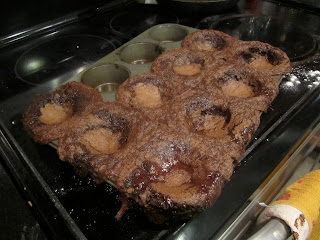
Cupcake Disaster

Ready?

(Cue stabbing music from the Psycho soundtrack.)


I don't know what happened. They just EXPLODED in the oven.

"I think it was the baking soda," said my son. "That's what makes science experiment volcanoes explode."

He just might be right. I was laughing too hard to answer him.

"How can you laugh at something like this?" he asked. "It was a total fail!"

"Because it's funny!" I squawked, and laughed all the harder.

Margot Fonteyn was right: "The one important thing I have learned over the years is the difference between taking one's work seriously and taking one's self seriously. The first is imperative and the second is disastrous."

There are some recipes that continue to elude me. Chocolate chip cookies like the ones sold in David's Cookies shops in New York before they all closed. Perfect parmesan-truffle fries. Great pan de sal and salsa monja, two favorites from home. And dark chocolate-raspberry cupcakes like the ones I had at a friend's wedding.

But I won't give up. Better luck next time!

Monday, August 2, 2010

Humanities and Medicine: All the Rage


There's been considerable buzz on the web the last few days - on the New York Times website, on Facebook, and on a physicians' forum called Sermo, at least - over a New York Times article from last Thursday entitled, "Getting Into Med School Without Hard Sciences."

The article describes the Humanities and Medicine Program at Mount Sinai Medical School, a program which each year admits into the medical school 35 undergraduates who major in the humanities or social sciences and can maintain a 3.5 GPA. Dr. Nathan Kase, who founded the program, said, "The default pathway is: Well, how did they do on the MCAT? How did they do on organic chemistry?...That excludes a lot of kids, but it also diminishes; it makes science into an obstacle rather than something that is an insight into the biology of human disease."

Students in the program, who apply during their sophomore or junior years of college, can forego taking the MCAT or physics, organic chemistry, and biology during college but do have a "boot camp" in those subjects at Mount Sinai prior to beginning their medical studies. A study published in the Journal of the AAMC entitled "Challenging Traditional Premedical Requirements as Predictors of Success in Medical School" has reopened the sometimes vitriolic debate over whether the traditional requirements should be revised or whether they are even necessary.

This discussion is not new; essayist Lewis Thomas, while defending the vital importance and inherent wonder of scientific learning, wrote about the need for more well-rounded physicians and published an essay entitled "Humanities and Science" in his popular work Late Night Thoughts On Listening to Mahler's Ninth Symphony. Many medical schools around the nation have included "humanities and medicine" curricula as part of their med students' training.

Most physicians who were science majors have of course come out in passionate defense of tradition, with some showing embarrassingly arrogant contempt for their counterparts in the humanities. They have called the Mount Sinai program an example of the "dumbing down" of American education, which I find patently offensive as a former English major who chose one of the most science-oriented specialties in medicine (but also, to my mind, one of the most artful).

I value what I learned in biochemistry about molecular pathways and receptors and in physics about pressure gradients and flow, but I also know that my training in the humanities contributed to my intellectual skill set in ways my science classes could not. I can think critically, listen to and interpret stories, write a narrative, learn foreign linggo, diagnose conditions based on various clues and signs, analyze situations, and make critical decisions because of the riches I gleaned from strong training in both the sciences and the humanities.

I still remember a surgeon who once answered a patient who was surprised she hadn't read a particular Shakespeare play, "Well, I spent my time reading things that would actually be useful to you for this operation." I find this attitude to a sound literary education small-minded and cheap. People without imagination so often focus on what is considered visibly "useful" without considering the intangible good done by less pragmatic knowledge. I was taught by some of the best teachers in the world that understanding a character or a line of poetry is not fluff compared to deriving an equation but rather a crucial component in the working of the mind and its interaction with the world.

During my training I was once asked in front of a patient to recite some respiratory physiology equation which, to my patient's approval, I was able to do easily at the time. But I wanted to say to the attending physician, "Ask me, too, what this patient's story is. I can tell you because I listened. I can tell you because I can put together and recreate a good narrative. And in the end it will help me take better care of this patient than knowing that equation." Good patient care is and, for me, always has been about story and relationship as well as facts and figures. We have to be able to do well working with both.

I find the habit of many physicians of looking down at the humanities and humanities students completely obnoxious, but of course, I am biased. I happen to think I'm a better doctor for having been well-educated one, with multiple aspects of the mind trained and challenged - not just the ones that can distinguish between an ester and an amide.